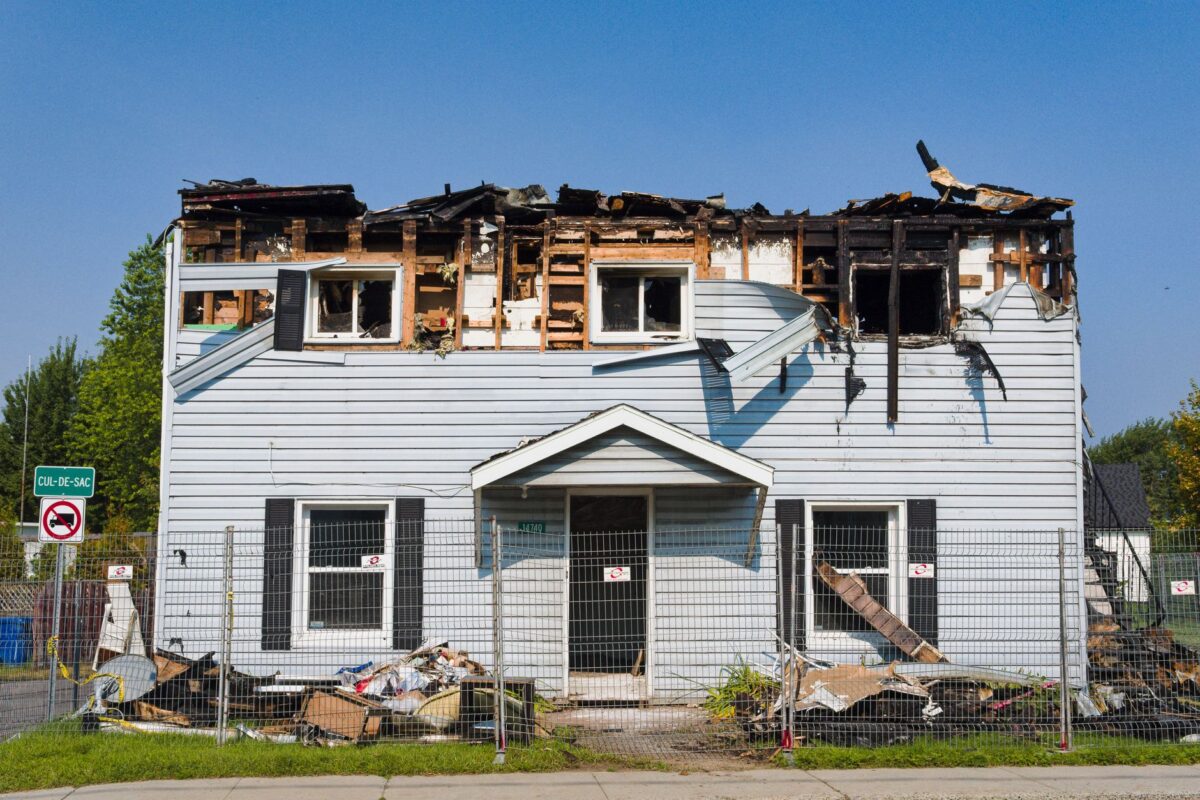
If your home burns down, the next few weeks will shape your financial recovery for years. Your homeowners policy is usually your biggest source of money to rebuild. However, many families are underinsured and do not learn it until after a fire. According to the Table of Contents
iii.org/fact-statistic/facts-statistics-homeowners-and-renters-insurance”>Insurance Information Institute, fire and lightning claims averaged about $84,000 per claim from 2018 to 2022. That is among the most expensive claim types in homeowners insurance. This guide explains how payouts work when a home burns down. It covers each part of your policy, what slows claims down, and the steps that protect your settlement.
How Insurance Pays When a Home Burns Down
A standard HO-3 policy splits your coverage into several parts. Each part has its own limit. When a home burns down, you may collect from all of them at once. The National Association of Insurance Commissioners (NAIC) advises reading your declarations page first. That page lists every limit and your deductible.
Coverage A pays to rebuild the house itself. Coverage B covers detached structures like fences and sheds. Typically, it equals 10% of your dwelling limit. Coverage C covers your belongings. In most cases, it is set at 50% to 70% of Coverage A. Coverage D pays additional living expenses (ALE) while you are displaced. It is often 20% to 30% of the dwelling limit.
For example, a $400,000 dwelling limit might carry $40,000 for other structures. It might also include $200,000 for contents and $80,000 for living expenses. Your deductible comes off the total claim once, not from each coverage.
Payout Breakdown: Replacement Cost vs. Actual Cash Value
How your policy values property matters a great deal. Replacement cost (RC) pays what it costs to rebuild or buy new today. Actual cash value (ACV) subtracts depreciation for age and wear. As a result, an ACV policy can pay far less after a home burns down.
Many RC policies pay in two stages. First, the insurer pays the ACV amount. Then it releases the “recoverable depreciation” once you rebuild or replace items. Deadlines to claim that holdback typically range from 180 days to two years. Missing that deadline can cost you thousands.
| Coverage Type | Typical Limit | What It Pays |
|---|---|---|
| Dwelling (A) | Your chosen limit | Rebuilding the house |
| Other Structures (B) | 10% of A | Garage, fence, shed |
| Personal Property (C) | 50%–70% of A | Furniture, clothing, electronics |
| Loss of Use (D) | 20%–30% of A | Rent, meals, temporary housing |
| Extended Replacement Cost | 25%–50% above A | Rebuild costs above your limit |
| Ordinance or Law | Often 10% of A | Upgrades required by new codes |
Extended replacement cost is key after a large wildfire. Construction prices often spike when many homes need rebuilding at once. Ordinance or law coverage matters too. Older homes must be rebuilt to current building codes. However, a base policy may not pay for those upgrades.
If you have a mortgage, the lender is usually named on the dwelling check. In most cases, the lender deposits the money in an escrow account. It then releases funds in stages as construction moves forward.
What to Do Right After Your Home Burns Down
Act quickly, but stay organized. The first 72 hours after a home burns down set the tone for your claim. Follow these steps:
- Stay safe. Do not enter the structure until the fire department clears it. The Ready.gov home fire guide explains post-fire safety.
- Report the claim right away. Call your insurer and write down your claim number and adjuster’s name.
- Request an ALE advance. Many insurers will advance living expense money within days.
- Get the fire report. Your local fire department issues it. Insurers typically require a copy.
- Document everything. Take photos and video of all damage before cleanup begins.
- Ask for a certified copy of your policy. You are entitled to the full policy, including endorsements.
Next, build your contents inventory. This is often the hardest step. Use photos, bank statements, and online order histories. Some states now ease this burden after declared disasters. For example, California requires insurers to advance a share of contents coverage without an itemized list. Check with your state insurance department for local rules.
🏠 Get Free Home Insurance Guides
Free · No spam · Unsubscribe anytime
Also watch your deadlines. Many policies require a sworn proof of loss within 60 days of the insurer’s request. Keep every receipt for hotels, meals, and mileage. As a result, your ALE reimbursement will be faster and complete.
If you disagree with the offer, you have options. You can request a detailed estimate and dispute specific items. Many policies also include an appraisal clause. In addition, you can hire a licensed public adjuster. They typically charge 10% to 20% of the settlement. However, some states cap those fees after declared disasters.
Frequently Asked Questions
How long does insurance take to pay if my home burns down?
Initial ALE advances often arrive within days. However, the full dwelling payout can take several months. Most states require insurers to accept or deny claims within 15 to 40 days after receiving proof of loss.
Do I have to rebuild on the same lot?
Typically, no. Many policies let you rebuild elsewhere or buy an existing home. However, you may only receive the ACV amount if you choose not to rebuild at all.
What if my coverage is not enough after my home burns down?
First, check for extended replacement cost or ordinance and law coverage. For example, a 25% extension adds $100,000 to a $400,000 limit. You may also qualify for FEMA assistance or SBA disaster loans if a disaster was federally declared.
Compare Home Insurance Rates
Ready to see if you could be paying less for homeowners insurance? Compare quotes from top insurers in your area. Getting multiple quotes is the most effective way to find a better rate.
(paid link)
Official Sources & Resources
For verified information on home insurance regulations and consumer protection:
- NAIC (National Association of Insurance Commissioners): naic.org
- Insurance Information Institute: iii.org
- FEMA (Federal Emergency Management Agency): fema.gov
- FloodSmart (National Flood Insurance Program): floodsmart.gov
- USA.gov — Housing: usa.gov/housing
Content last reviewed September 2026. If you notice any outdated information, please contact us.