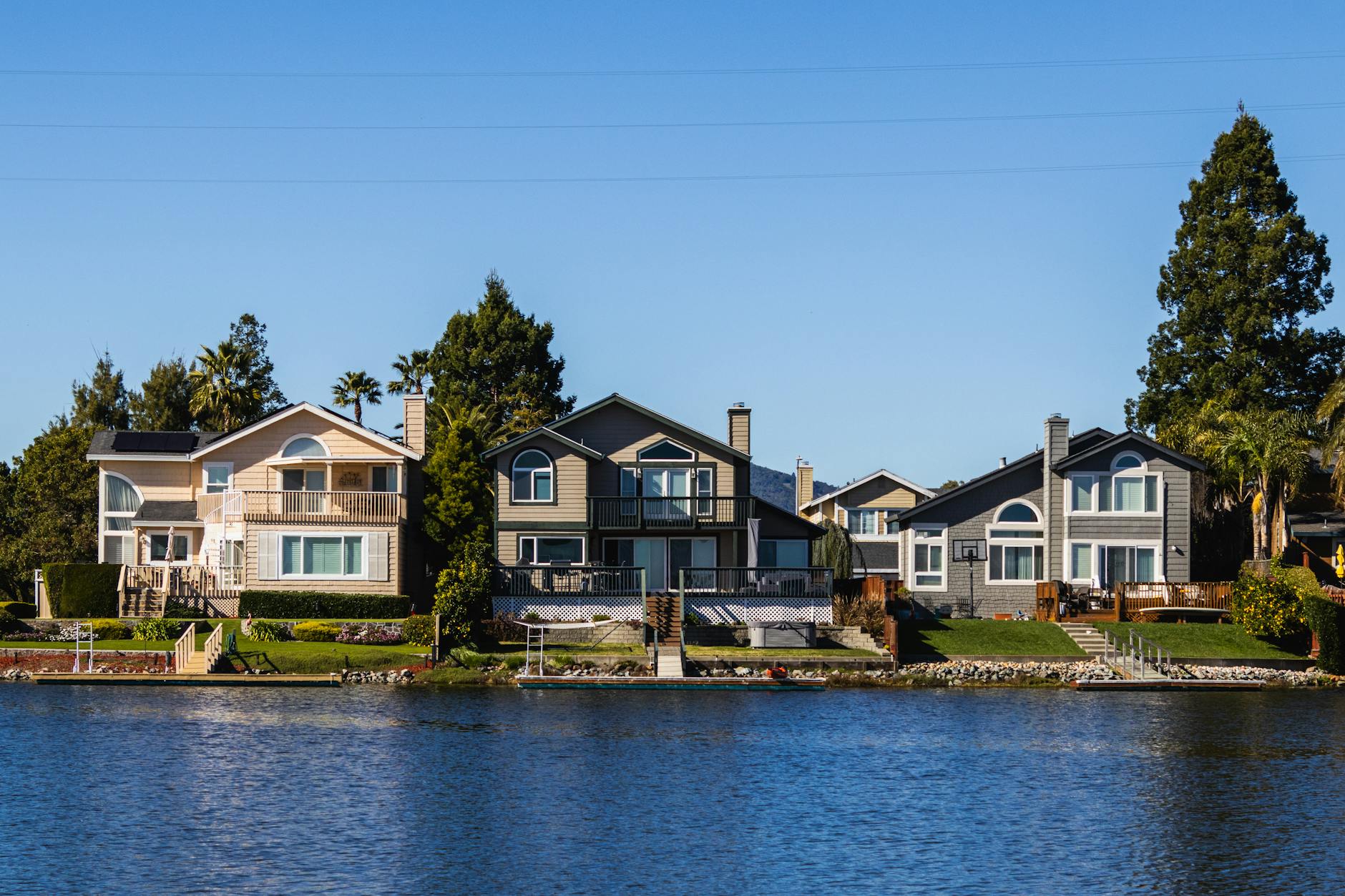
Living near water home insurance is a growing concern for millions of American homeowners. According to First Street Foundation, 14.6 million U.S. properties face substantial flood risk.
- Understanding the Risk: Living Near Water Home Insurance
- What Standard Homeowners Insurance Covers (and Doesn’t)
- Additional Coverage Options for Living Near Water Home Insurance
- How Much Does Living Near Water Home Insurance Cost?
- How to Reduce Your Risk and Lower Premiums
- Frequently Asked Questions
That number is 67% higher than traditional FEMA flood maps suggest. Standard homeowners insurance does not cover flood damage. Storm surge, rising water, and coastal erosion are all excluded from typical HO-3 policies. However, many homeowners discover these gaps only after disaster strikes. In 2024, Hurricanes Helene and Milton caused over $100 billion in combined damage across six states. As a result, understanding living near water home insurance has never been more critical for protecting your property and finances.
Understanding the Risk: Living Near Water Home Insurance
FEMA classifies flood risk using Special Flood Hazard Areas (SFHAs). Zone A and Zone AE face a 1% annual chance of flooding. Zone V and Zone VE carry that same risk plus storm-induced wave hazards. These high-risk zones have at least a 26% chance of flooding during a 30-year mortgage. However, flooding is not limited to these zones. Roughly 25% of all NFIP claims come from moderate- and low-risk areas outside SFHAs.
The financial impact is staggering. Just one inch of floodwater can cause approximately $25,000 in damage. The average NFIP claim payout between 2020 and 2024 was $82,614. Annual U.S. flood damage costs average $46 billion per year over the past decade. For example, FEMA’s Risk Rating 2.0 now uses individualized pricing to better reflect each property’s true exposure.
Coastal states bear the heaviest burden. Florida, Louisiana, and Texas have the most residents in high-risk flood areas. Climate Central projects that 2.5 million people in 1.4 million homes face severe coastal flooding risk by 2050. In South Florida alone, 2024 map updates added 138,800 structures to high-risk zones. Living near water home insurance decisions in these areas carry enormous financial weight.
What Standard Homeowners Insurance Covers (and Doesn’t)
Standard HO-3 and HO-5 policies cover wind-driven rain entering through a damaged roof. They also cover burst pipes and sudden internal water damage. However, they exclude all forms of external flooding. Surface water, river overflow, storm surge, and groundwater seepage are not covered. Sewer and drain backup also require a separate endorsement. This distinction surprises many homeowners who assume their policy handles all water damage.
In most cases, the key dividing line is simple. Water that falls from above may be covered. Water that rises from below is not. Storm surge — even when caused by a hurricane — is classified as flooding. As a result, living near water home insurance requires separate flood coverage at minimum. Many coastal homeowners also need windstorm policies. In 19 states plus Washington D.C., hurricane deductibles apply separately from standard deductibles.
Additional Coverage Options for Living Near Water Home Insurance
The National Flood Insurance Program (NFIP) is the primary source of flood coverage. It operates in over 22,000 communities nationwide. NFIP residential policies cover up to $250,000 for building damage and $100,000 for contents. The national average premium is approximately $900 per year under Risk Rating 2.0. However, high-risk properties pay significantly more. Private flood insurers may offer higher coverage limits and competitive pricing.
State-specific programs fill additional gaps in living near water home insurance. Florida’s Citizens Property Insurance now covers over 1.4 million policies after major carriers withdrew from the state. The Texas Windstorm Insurance Association (TWIA) provides wind and hail coverage across 14 coastal counties. Louisiana Citizens saw policies triple from 48,000 to 184,000 between 2021 and 2023. FAIR Plans exist in most states as insurers of last resort for hard-to-place properties.
| Coverage Type | What It Covers | Where to Get It | Typical Cost |
|---|---|---|---|
| NFIP Flood Policy | Rising water, storm surge, surface flooding | FloodSmart.gov or licensed agents | $900/year avg. |
| Private Flood Insurance | Same as NFIP, often higher limits | Private insurers (Neptune, Wright, etc.) | Varies widely |
| Windstorm/Hurricane Policy | Wind and hail damage in coastal zones | TWIA, state wind pools, FAIR Plans | $2,480/year avg. (TWIA) |
| Sewer Backup Endorsement | Drain/sewer overflow into home | Added to standard homeowners policy | $50–$250/year |
| Excess Flood Insurance | Coverage above NFIP $250K limit | Private surplus lines carriers | $500–$1,500/year |
How Much Does Living Near Water Home Insurance Cost?
Location is the biggest cost driver. In Florida, the average homeowners premium reaches $5,500 per year — roughly $3,350 above the national average. Fort Lauderdale coastal properties average $8,347 annually. Meanwhile, inland Orlando averages just $2,510. Louisiana homeowners pay about $5,986 per year on average. Texas coastal cities like Galveston can exceed $10,000 annually when flood and wind policies are combined.
Nationally, homeowners premiums increased 24% over the past three years. Reinsurance costs rose 25% to 33% since 2022. For example, living near water home insurance in a FEMA Zone VE can cost three to five times more than a Zone X property just miles inland. Under Risk Rating 2.0, 96% of NFIP policyholders see increases of $20 per month or less. However, high-value coastal properties face the steepest adjustments.
The cost of not having coverage is far worse. Typically, federal disaster assistance after a flood averages only $5,000 to $10,000 in grants. FEMA disaster loans must be repaid with interest. Living near water home insurance — even at elevated premiums — is consistently cheaper than rebuilding out of pocket.
How to Reduce Your Risk and Lower Premiums
Elevation is the single most effective mitigation strategy. Raising your first floor above the base flood elevation can cut flood premiums in half or more. An Elevation Certificate documents your home’s height relative to the floodplain. Without one, FEMA assumes worst-case scenario and charges accordingly. Obtaining this certificate alone can reduce premiums by 50% or more.
Installing engineered flood vents in foundations can lower premiums by up to 25%. Sump pumps, backflow valves, and water alarms also help under Risk Rating 2.0 scoring. For example, living near water home insurance costs drop when communities participate in FEMA’s Community Rating System. Over 1,500 communities earn CRS discounts ranging from 5% to 45% on flood premiums. These communities hold 69% of all NFIP policies.
Additional steps make a measurable difference. Move electrical panels and HVAC systems above potential flood levels. Use flood-resistant building materials on lower floors. Maintain proper drainage and grading around your foundation. Typically, combining several mitigation measures produces the best results for living near water home insurance savings. Contact your local floodplain manager to identify which improvements qualify for premium reductions in your area.
Frequently Asked Questions
Do I need flood insurance if I’m not in a FEMA flood zone?
In most cases, yes. About 25% of NFIP flood claims come from outside high-risk zones. However, premiums in low-risk Zone X areas are significantly cheaper. Living near water home insurance protection is wise regardless of your official zone designation.
Does living near water home insurance cover storm surge damage?
Standard homeowners insurance does not cover storm surge. It is classified as flood damage by insurers. As a result, you need a separate NFIP or private flood policy to cover storm surge losses.
How far from water do I need to be for insurance rates to drop?
Distance alone does not determine your rate. FEMA’s Risk Rating 2.0 considers elevation, flood frequency, distance to water, and rebuilding costs. Typically, properties above the base flood elevation see the largest premium reductions regardless of proximity.
Compare Home Insurance Rates
Ready to see if you could be paying less for homeowners insurance? Compare quotes from top insurers in your area. Getting multiple quotes is the most effective way to find a better rate.
(paid link)
Official Sources & Resources
For verified information on home insurance regulations and consumer protection:
- NAIC (National Association of Insurance Commissioners): naic.org
- Insurance Information Institute: iii.org
- FEMA (Federal Emergency Management Agency): fema.gov
- FloodSmart (National Flood Insurance Program): floodsmart.gov
- USA.gov — Housing: usa.gov/housing
Content last reviewed April 2026. If you notice any outdated information, please contact us.