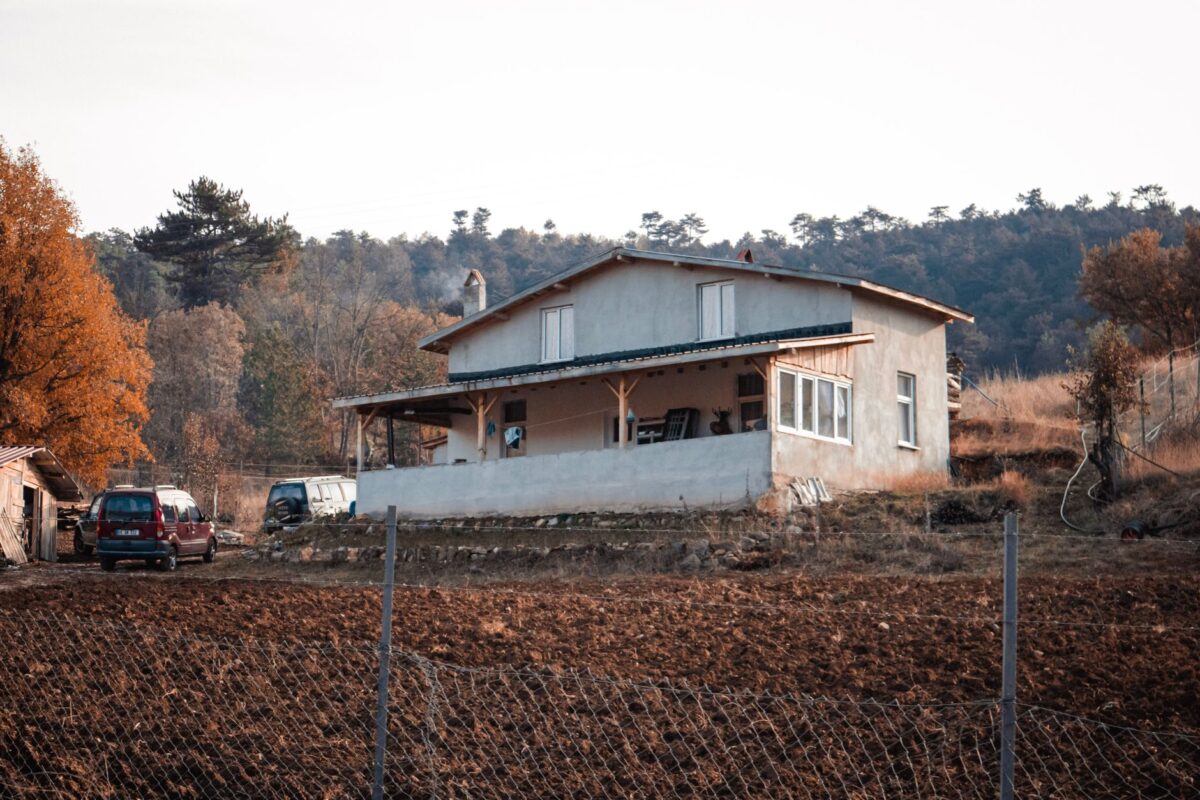
shelter vs country financial home insurance is a matchup that almost never shows up on national “best insurers” lists. That is exactly why it matters. Both companies were built by farm organizations to cover the homes that big national carriers either overprice, underwrite harshly, or simply decline. If you own five acres outside a town of 3,000, with a pole barn, a detached shop, and a gravel driveway, State Farm and Progressive may quote you as if you lived in a subdivision.
Shelter and Country Financial were designed for your address instead. However, the two companies are not interchangeable. They write in different states, price acreage differently, and handle farm-adjacent risk in very different ways. This guide compares them on the things rural homeowners actually get denied for.
One thing to settle immediately: these two carriers do not share a parent company. They are separate mutual organizations with similar origin stories. Shelter began in 1946 as MFA Mutual, the insurance arm of the Missouri Farmers Association. Country Financial traces to 1925, when the Illinois Agricultural Association — today the Illinois Farm Bureau — chartered Farmers Mutual Reinsurance Company. Same instinct, different states, different underwriting.
Shelter Vs Country Financial Home Insurance: Quick Comparison
| Feature | Shelter Insurance | Country Financial |
|---|---|---|
| Average annual rate | ~$2,100 (varies widely; $250K dwelling) | ~$2,540 ($250K dwelling) |
| AM Best rating | A (Excellent) | A+ (Superior) |
| J.D. Power standing | Repeat regional winner; #1 Central region auto 8 of last 9 years | Consistently above segment average; below Amica’s category-leading 705 |
| NAIC complaint ratio | Well below expected (roughly half the norm) | Well below expected for its size |
| States available | 15 | 19 |
| Bundling discount | Up to about 20% | Up to 25% |
| Claims satisfaction | Strong; agent-led, local adjusters | Strong; agent-led, farm-trained adjusters |
| Mobile app rating | ~4.6 iOS / ~4.3 Android | ~4.7 iOS / ~4.4 Android |
| Founded | 1946 (Columbia, Missouri) | 1925 (Bloomington, Illinois) |
| True farm policy? | Yes — Farm Property Insurance | Yes — full Farm & Ranch line |
Availability decides this comparison for many readers. Shelter writes in Arkansas, Colorado, Illinois, Indiana, Iowa, Kansas, Kentucky, Louisiana, Mississippi, Missouri, Nebraska, Nevada, Ohio, Oklahoma and Tennessee. Country Financial writes in Alabama, Alaska, Arizona, Colorado, Georgia, Idaho, Illinois, Indiana, Iowa, Kansas, Minnesota, Missouri, Nevada, North Dakota, Oklahoma, Oregon, Tennessee, Washington and Wisconsin.
That leaves only nine overlap states: Colorado, Illinois, Indiana, Iowa, Kansas, Missouri, Nevada, Oklahoma and Tennessee. Outside those nine, shelter vs country financial home insurance is not really a choice. For example, a Kentucky or Mississippi homeowner can only get Shelter. A Wisconsin, Minnesota or Oregon homeowner can only get Country Financial. Check availability first, then read the rest.
Coverage Options: Shelter vs Country Financial
Both carriers sell standard HO-3 and HO-5 policies. Both cover dwelling, other structures, personal property, loss of use and liability. The real difference shows up in Coverage B — other structures — and in what happens when a structure is used for anything agricultural.
Shelter’s homeowners policy handles typical detached structures well. Fences, sheds and detached garages fall under other structures coverage. However, once a building serves a farming purpose, Shelter moves it. Barns, granaries, machine sheds and second farmhouses go onto Shelter’s separate Farm Property policy under optional farm structures coverage. In most cases your agent writes the home and the farm structures together, so the split is administrative rather than a coverage gap.
Country Financial takes a broader swing at the same problem. Its Farm & Ranch line is one of the most developed in the Midwest, covering outbuildings, machinery, livestock, hay and stored grain. On the other hand, Country Financial is also comfortable extending a plain homeowners policy across meaningful acreage without pushing you into a farm form. That matters if you own 10 or 20 acres you do not actually farm. Typically Country Financial is the easier “acreage but not a farm” underwrite, which is a real advantage in the shelter vs country financial home insurance decision.
Optional add-ons run close on both sides. Expect equipment breakdown, water backup, service line coverage, identity theft and scheduled personal property from each. Both offer replacement cost on dwelling and contents. Neither carrier is generous about guaranteed replacement cost on older rural homes, so ask specifically about extended replacement cost percentages. Shelter and Country Financial both write well-drilled water systems and septic into service line endorsements — something several national carriers now exclude.
Rates and Discounts: Shelter vs Country Financial
Published averages for these two carriers vary enormously by source, because both price by county rather than by state. Sample quotes for Country Financial run roughly $1,962 to $2,684 annually for $250,000 in dwelling coverage, with about $2,540 as a common midpoint. High-value homes climb steeply — around $7,783 for $1 million in dwelling. Shelter’s sample rates land in a similar band in its core Midwest states, though at least one third-party study quoted $5,955 for $300,000 in coverage, which suggests certain wind-exposed territories get priced hard.
| Discount | Shelter | Country Financial |
|---|---|---|
| Multi-policy (home + auto) | Up to ~20% | Up to 25% |
| Dwelling age / newer home | Yes | Up to 40% |
| Updated wiring | Yes | Up to 28% |
| New or updated roof | Yes | Up to 20% |
| Alarm / protective device | Yes | Up to 15% |
| Safe heat (no wood stove issues) | Underwriting factor | Up to 15% |
| Smart home devices | Limited | Yes |
| Claims-free / loyalty | Yes | Yes (welcome discount too) |
Country Financial publishes deeper discount percentages, and the wiring and dwelling-age credits are unusually large. Those two credits punish old rural farmhouses and reward updated ones. For example, a 1910 farmhouse with knob-and-tube wiring will lose most of that 28%. Shelter discloses less, but its base rates in Missouri, Kansas and Arkansas are often lower before discounts. In practice, shelter vs country financial home insurance comes down to a real quote from both, not a rate table.
Bundling is where both carriers make their money back for you. Country Financial’s 25% multi-policy credit is among the strongest in the rural market. Before you commit, it is worth checking whether your auto premium is competitive on its own — you can compare auto insurance rates at Car Cover Guide to see whether the bundle is genuinely cheaper or just convenient. Many homeowners find the combined discount only wins when the auto rate was already reasonable.
Claims Process and Customer Service
Neither company is a direct-to-consumer operation. Both run on captive local agents, and both require a phone call or agent visit to actually bind a policy. You can start a Country Financial quote online, but a representative must finish it. Shelter works the same way, through roughly 1,400 agents.
Claims filing is available by phone, through the agent, or in-app at both carriers. Typically both dispatch a staff adjuster rather than an independent contractor, which is why rural claim handling tends to go smoothly. Country Financial’s adjusters are farm-trained in its agricultural states, so a collapsed machine shed or a hail-shredded grain bin roof gets handled by someone who has seen one before. Shelter’s adjusters in Missouri and Kansas have the same depth on wind and hail.
Satisfaction data favors both. Shelter has earned J.D. Power’s highest customer satisfaction ranking among Central region auto insurers in eight of the last nine study years, including 2026, ranking first in trust and problem resolution. Country Financial scores consistently above segment average in the U.S. Home Insurance Study, though neither carrier approaches Amica’s category-leading 705 on the 1,000-point scale. NAIC complaint data is quietly the best evidence here: both draw meaningfully fewer complaints than expected for their size, and Shelter’s home complaint volume runs roughly half the norm.
🏠 Get Free Home Insurance Guides
Free · No spam · Unsubscribe anytime
Financial Strength and Stability
Country Financial holds an A+ (Superior) rating from AM Best. Shelter holds an A (Excellent). Both are strong. However, A+ is one notch higher, and that gap is genuine if you are insuring a high-value property or you plan to keep the policy for decades.
Size differs too. Country Financial is the larger organization, with a life, investment and farm business layered on top of property and casualty, and 19 states of footprint. Shelter is smaller and more concentrated, operating as a policyholder-owned mutual across 15 states with a substantial reinsurance arm behind it. Neither is publicly traded, so neither faces quarterly pressure to shed rural policies the way some national carriers have since 2023.
That stability is the underrated argument in shelter vs country financial home insurance. Both companies have stayed in small-town markets that national insurers exited. For example, non-renewals across wind-exposed Plains counties hit national books hard, while these two kept writing. Neither has the balance sheet of a Chubb, but neither has shown a pattern of abandoning territory either.
Which Home Insurer Should You Choose?
Choose Shelter if: You live in Kentucky, Mississippi, Arkansas, Louisiana, Nebraska or Ohio, where Country Financial does not write at all. You want the lowest base rate in Missouri or Kansas before discounts are applied. You value an agent you can physically walk into an office to see. You own a modest rural home with a couple of outbuildings and want a straightforward home-plus-farm-structures pairing.
Choose Country Financial if: You live in Wisconsin, Minnesota, Oregon, Washington, Georgia, Alabama, Arizona, Idaho, North Dakota or Alaska — Shelter is unavailable in all of them. You own real acreage and want it under one policy without being forced onto a farm form. You have an updated roof, modern wiring and a newer dwelling, which stacks credits worth up to 40%, 28% and 20%. You run an actual working farm and want home, farm, machinery and livestock with one agent and a 25% bundle.
The honest verdict: in the nine overlap states, Country Financial is the stronger pick for larger acreage, updated homes and working farms, backed by the A+ rating and deeper discount schedule. Shelter is the better pick for smaller rural properties, tight budgets, and its six exclusive states. Get both quotes if you can — the county-level pricing means the winner genuinely flips by ZIP code. Whichever you pick, the savings are worth redirecting; you can find bank sign-up bonuses at Bonus Bank Daily and park a lower premium somewhere it earns.
Frequently Asked Questions
Are Shelter and Country Financial owned by the same company?
No, and this is a common mix-up. Shelter began in 1946 as MFA Mutual under the Missouri Farmers Association. Country Financial started in 1925 under the Illinois Agricultural Association, now the Illinois Farm Bureau. They are separate mutual organizations with similar farm-group roots.
Which one covers a barn or machine shed on my property?
Both do, but differently. Shelter typically moves farm buildings onto its separate Farm Property policy under optional farm structures coverage. Country Financial can often keep outbuildings on a homeowners form, or write its full Farm & Ranch line if you actually farm.
Can I get both quotes where I live?
Only in nine states: Colorado, Illinois, Indiana, Iowa, Kansas, Missouri, Nevada, Oklahoma and Tennessee. Everywhere else, one of them is unavailable. For example, Kentucky and Mississippi are Shelter-only, while Wisconsin and Minnesota are Country Financial-only.
Compare More Home Insurance Companies
Looking for more home insurance reviews, comparisons, and state guides? Browse our complete library of insurance resources.
Official Sources & Resources
For verified information on home insurance ratings and regulations:
- AM Best (Financial Strength Ratings): ambest.com
- NAIC (Complaint Ratios): naic.org
- Insurance Information Institute: iii.org
- FEMA (Flood Insurance): fema.gov
- J.D. Power (Customer Satisfaction): jdpower.com
Content last reviewed August 2026. If you notice any outdated information, please contact us.