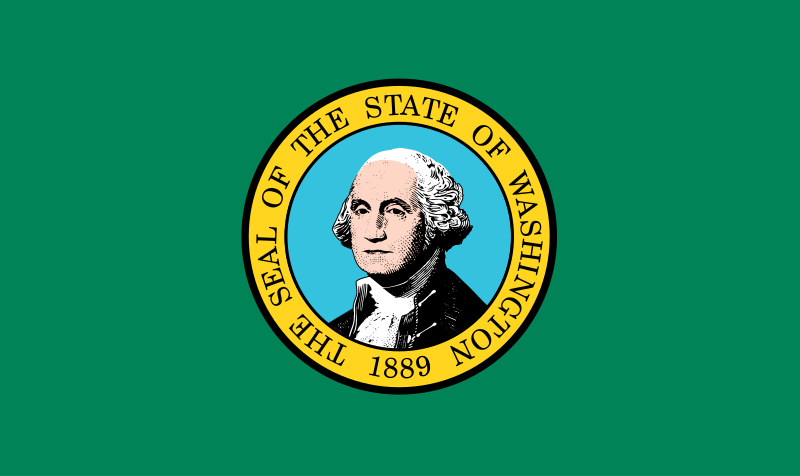
Washington Dog Bite Law decides who pays when a dog injures someone — and the answer changes a great deal from one state to the next. This guide explains whether Washington uses strict liability or the one-bite rule, how long you have to file, how leash and dangerous dog rules work, and exactly how a homeowners policy responds. Whether you own a dog in Washington or you were bitten by one, Washington Dog Bite Law is what determines the outcome.
Washington Dog Bite Law is summarized here in plain English. Everything in this guide was verified against Washington statutes, the state courts, and Insurance Information Institute claim data as of August 2026.
In This Washington Dog Bite Law Guide:
Washington Dog Bite Law: Strict Liability or One-Bite Rule?
Washington is a strict liability state for dog bites. That means a dog owner is responsible for the injury even if the dog had never bitten anyone before and even if the owner did everything right. The victim does not have to prove the owner was careless.
The governing statute is RCW 16.08.040. Statutes are amended, so confirm the current text before relying on it in a claim.
Washington makes a dog owner liable for damages when their dog bites a person who is in a public place or lawfully on private property, including the owner’s own property, regardless of whether the dog had ever bitten before or the owner knew it was vicious. A bite victim does not have to prove the owner was careless — only that a bite happened and that they were lawfully present. An owner cannot escape liability by showing the dog had a clean history, but the statute does not apply to the lawful application of a police dog under RCW 4.24.410.
Important limit: the Washington rule covers bites. If a dog knocks someone down, scratches them, or causes a fall, that claim normally has to be brought as ordinary negligence instead.
Filing Deadline Under Washington Dog Bite Law
A dog bite lawsuit in Washington must be filed within 3 years of the date of the injury (RCW 4.16.080). Miss that deadline and the claim is normally barred no matter how strong it is.
The deadline for notifying an insurance company is much shorter than the deadline for filing suit. Most homeowners policies require prompt notice, so report the incident to the insurer right away even if you have not decided whether to sue.
How Washington Dog Bite Law Treats Leash Laws and Dangerous Dogs
Washington has no general statewide leash requirement; leash and running-at-large rules are set by city and county ordinance. State law addresses only narrow situations — RCW 16.08.010 and 16.08.020 make an owner liable for livestock and poultry killed or injured by a dog and require the owner to leash or confine a dog after being notified it has chased or bitten domestic animals, and RCW 16.08.090 requires a declared dangerous dog to be muzzled and leashed under physical restraint whenever it is outside its proper enclosure.
Under RCW 16.08.070–16.08.100, a dog may be declared “potentially dangerous” or “dangerous” based on its behavior (severe injury to a person without provocation, killing a domestic animal off the owner’s property, or repeat aggression after a potentially-dangerous finding). An owner of a declared dangerous dog must obtain an annual certificate of registration, keep the dog in a locked, secure proper enclosure, and muzzle and leash it under a responsible person’s physical restraint when outside — failure means immediate confiscation and possible destruction under RCW 16.08.100.
Liability insurance requirement: YES — $250,000 (surety bond of at least $250,000 payable to any person injured by the dog, or a liability insurance policy of at least $250,000, per RCW 16.08.080). This is a legal obligation once a dog is formally declared dangerous, and a standard homeowners policy may not satisfy it.
Leash rules matter far beyond the ticket. In a strict liability state, breaking a leash ordinance is powerful evidence of negligence, and it can defeat an owner’s defense outright.
Washington Dog Bite Law and Homeowners Insurance
Dog bites are normally paid under the personal liability section of a standard homeowners policy — Coverage E — not under the part that repairs your house. Renters policies carry the same liability coverage.
Two other pieces of the policy come into play. Medical payments coverage (Coverage F) pays a modest amount of the injured person’s medical bills with no finding of fault, which often settles a minor bite quietly. And an umbrella policy sits above your liability limit — the single most useful thing a dog owner in Washington can buy.
Coverage is not automatic. Most policies exclude injuries to people who live in your household, deliberate acts, and business-related animals. Some exclude a dog with a prior bite on record. Read the exclusions before you need them, not after.
🏠 Get Free Home Insurance Guides
Free · No spam · Unsubscribe anytime
Unique to Washington: RCW 16.08.110 (enacted 2019) bars a city or county from banning or restricting a dog by breed, or declaring it dangerous by breed, unless the jurisdiction maintains a process letting any dog earn an exemption by passing the AKC Canine Good Citizen test or an equivalent behavioral test, with the exemption lasting at least two years and retesting available — so local breed bans survive only with a good-behavior escape hatch.
Dog Bite Claim Costs in Washington
Washington Dog Bite Law decides who is liable. The claim figures below show what that liability actually costs when it lands.
Dog bite claims are one of the largest single categories of homeowners liability payouts. Here is what the numbers look like in Washington:
| Dog bite claims filed | 439 |
| Average cost per claim | $88,529 |
| Data year | 2024 |
| Typical liability limit | $300,000 |
The gap between the average claim and a typical liability limit is the reason underinsurance matters here. A severe attack involving reconstructive surgery can run well past a $300,000 limit, and the owner pays the rest personally.
Washington Dog Bite Law, Breed Restrictions and Insurance Exclusions
Washington permits local breed-specific ordinances. Some cities and counties restrict or ban particular breeds, and violating a local ban can also be used against you in a civil claim.
Insurers in Washington are generally free to refuse or surcharge coverage based on breed. This is a real risk — a policy can be non-renewed after an insurer learns which dog lives at the address.
Breeds most often excluded or surcharged by insurers:
- Pit Bull
- Rottweiler
- Doberman Pinscher
- German Shepherd
- Chow Chow
- Akita
- Presa Canario
- Wolf hybrid
Landlord and Property Owner Liability
Washington follows Clemmons v. Fidler (1990) and Frobig v. Gordon (1994): only the owner, keeper, or harborer of the animal is liable, and a landlord has no duty to protect third parties from a tenant’s lawfully owned dangerous animal even if the landlord knows the animal is there. A landlord can be exposed only in narrow circumstances, such as where the landlord actually keeps or harbors the dog or retains control over the area where the attack occurred.
Under Washington Dog Bite Law the tenant who owns the dog is the first target of a claim, but a landlord with knowledge of a dangerous animal can be pulled in alongside them.
If you rent out property in Washington, this is worth taking seriously — see our guide to liability coverage and what happens when someone is hurt on your property.
Defenses Available Under Washington Dog Bite Law
Defenses recognized in Washington:
- Trespassing
- Provocation
- Comparative fault
- Police or military dog exemption
These defenses rarely erase a claim by themselves. They more often reduce what an owner pays, which under comparative fault rules can still be a substantial difference.
How to Lower Your Liability Risk
Washington Dog Bite Law sets the standard you will be judged against. These are the steps that reduce both the chance of a bite and the size of the bill if one happens:
- Raise your liability limit. Going from $100,000 to $300,000 usually costs very little per year.
- Add an umbrella policy. $1 million of extra liability typically runs $150-$300 a year.
- Tell your insurer about the dog. A non-disclosed dog is a reason to deny the claim later.
- Check your local leash ordinance. A violation is evidence against you in a civil case.
- Secure the yard and post a sign. Fencing and gate latches prevent the bite in the first place.
- Document training and vet visits. A record of responsible ownership supports the defense that you had no notice the dog was dangerous.
(paid link)
Official Sources & Resources
- Insurance Information Institute — dog bite liability: iii.org
- CDC — dog bite prevention: cdc.gov
- American Veterinary Medical Association: avma.org
- Washington State Office of the Insurance Commissioner: https://www.insurance.wa.gov/
- NAIC: naic.org
This is a plain-English summary of Washington Dog Bite Law, not legal advice. Statutes change and every bite turns on its own facts — talk to a licensed Washington attorney about a specific claim. Last verified August 2026. If something here looks out of date, please contact us.